
Why Speaking Still Fails in Real Life Even After Learning the Language
Speaking a new language isn’t just about grammar or vocab
Relocating to a new country often means learning to live again in a different language. For many immigrants, the hardest part is not understanding vocabulary or grammar, but speaking in real-life situations where there is pressure, uncertainty, and fear of making mistakes. Simple everyday interactions such as speaking at a healthcare centre, interacting with public authorities, calling an electrician to report a fault, or even asking for help in a store — these situations can quickly become stressful when speaking confidence is low.
Research in second language acquisition consistently shows that speaking develops more slowly than receptive skills such as reading and listening because it requires simultaneous vocabulary retrieval, grammatical processing, pronunciation, and real-time interaction under pressure (Levelt, 1989; DeKeyser, 2007; Skehan, 2009). Speaking is uniquely demanding because it requires simultaneous lexical retrieval, grammatical processing, and pronunciation under real-time pressure (Segalowitz, 2010). Unlike reading or writing, real conversation has no pause button. Everything happens instantly.
Speaking anxiety: the hidden barrier
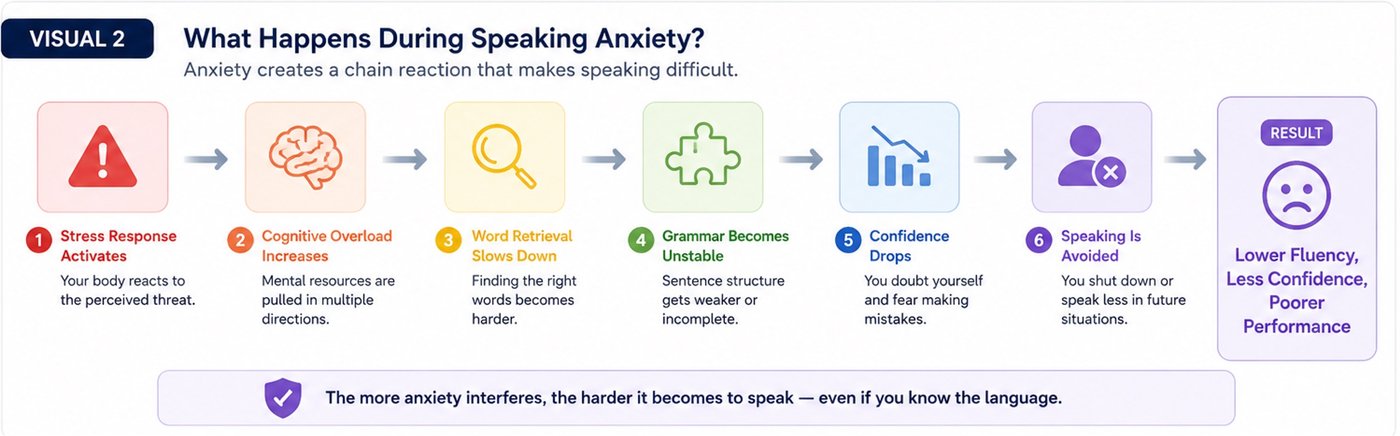
Speaking difficulties are not only about vocabulary or grammar but also about confidence in real-life situations. Many language learners feel nervous or hesitant when speaking, especially in unfamiliar or high-pressure environments, a phenomenon often referred to as speaking anxiety.
Wang and Zhang (2021) identify speaking anxiety as a major barrier in foreign language learning, often associated with physiological stress responses (Lader, 1972) that appear as nervousness during communication. These reactions can disrupt cognitive processing, leading to reduced fluency, lower confidence, and weaker overall speaking performance. Conversely, however, making mistakes or mispronouncing words is widely recognised as a normal and unavoidable part of learning a new language (Nguyen, 2025; Krashen & Terrell, 1983). It is through these moments of imperfection that fluency and confidence gradually develop.
Recent research also suggests that AI-supported language practice can help reduce these barriers by creating a low-pressure environment where learners can practice speaking more freely and consistently before facing real-world interactions. Studies on AI conversational agents, online speaking environments, and technology-supported learning show improvements in learner confidence, willingness to communicate, and reduced speaking-related stress (Zhang & Li, 2025).